A practising optimist: Richard's story
Richard explains how exercise, good friends and taking part in research help him stay positive.
Reading time: 5 minutes
Richard Harvey still remembers his prep school’s end-of-term report from the 1950s, which was signed off by the headmaster with a note reading: "Richard does not take life seriously."
"Spot on!" he remarks, "and a philosophy I have maintained over the years." Richard’s sense of humour served him well during a visit to his "happy place", Ronnie Scott’s Jazz Club in London. He remembers: "I bent down to re-tie one of my shoelaces in the gents, and slid slowly to the floor. Fortunately, one chap spotted me and hauled me to my feet. All I could do was thank him, weakly adding: ‘bloody Parkinson’s’, in case he thought I’d had too much to drink."
Taking charge
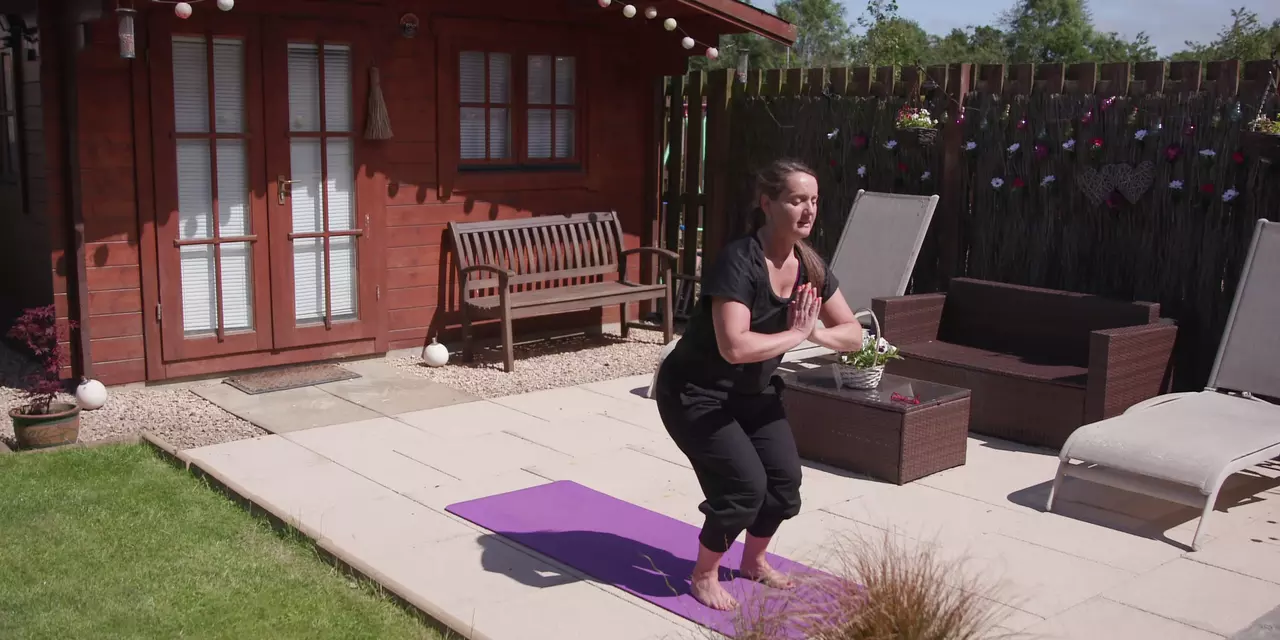
A few months before his diagnosis in early 2022, Richard had already decided to get fit, in the hope it would help stave off what he now knows were the early signs of Parkinson’s. "I had had some warning signs. For months I had experienced a slightly dragging left leg, sudden freezing on the spot, and difficulty with buttons and getting in and out of bed."
I vowed to approach and minimise the impact of Parkinson’s with pragmatism, positivity and humour.
Like many people, over the years Richard had signed up for gym memberships only to lapse after a couple of months. "But the news I had Parkinson’s provided a deeply personal reason and motivation to train," he says.
"So I did a bit of online searching and found Tom Roach, a Scouse ex-Irish Guards captain and physical training instructor. Sessions with him can be summed up in one word: knackering. Pumping weights, leg-strengthening exercises, short sprints, running up and down stairs, step ups and push-ups are all part of the routine."
Richard also joined local organised walks every Wednesday and Friday. "Trekking through the beautiful countryside around my Kentish home town of Tenterden is nowhere near as demanding as sessions with Tom, but it's good for the soul," he says.
"Within a matter of weeks, the sessions with Tom plus the drugs and the walks meant I was able to stand up from a chair without difficulty, climb into bed easily, and do up the buttons on my shirt without asking my wife Helen to help."
Word spreads
"A year later, news of my Parkinson’s had spread among friends and family who were supportive, none more so than Helen, my rock, to coin a cliché, and my daughter Emma," Richard says. He also had plenty of support from friends made during a long career in journalism, PR and crisis management.
"My old mates were, as I fully expected, determined to cheer me up with some dark humour over lengthy liquid lunches," Richard says. "Many of them were facing their own health issues, so conversations were along the lines of ‘I’ll see your Parkinson’s disease, and raise you prostate cancer and a hip replacement.’"
One unexpected symptom was a newfound tendency to cry more easily: "I tended to tear up a bit at ‘The Repair Shop’ (the TV programme where people bring in heirlooms, many of great sentimental value, to be restored) and any number of pieces of music."
Under the microscope
The more he read about Parkinson’s, the more it appeared to be underfunded compared to other conditions, Richard reflects. "So it was a pleasant surprise to find that Parkinson’s UK was driving ahead with several research projects, hopefully bringing closer the day when the disease could be stopped in its tracks, or even banished altogether.
"I signed up as a volunteer to take part in trials, which led me to participate in a study aiming to find out why proteins build up inside the brains of Parkinson’s patients, and what impact disturbed sleep had on this process."
At William Harvey Hospital in Ashford, a Parkinson’s specialist put him through a series of physical and mental tests, and took a blood sample. "Without bragging, I thought that overall I had done pretty well, but more was to come. I was given a wristwatch device to monitor my sleep over a 14-day period, asked to keep a sleep diary and complete an online survey with another series of tests to measure attention and memory." Richard was just one of 300 people with Parkinson’s who took part in this study.
I’m sure we all felt that if we could do anything, no matter how insignificant, to help science solve the baffling enigma of this disease, then it was more than worthwhile.
More support
Meanwhile, Richard’s symptoms were starting to progress: "I noticed more dribbling, greater difficulty in turning over in bed, walking more slowly, and an increase in the number of days when my energy levels were pretty much flat on the ground."
He’d also been finding it increasingly difficult to sleep because of restless legs syndrome, which can be a symptom of Parkinson’s or a side effect of medication. "Most nights were interrupted with one or other of my legs repeatedly doing a spasmodic tango. This might be useful if I was planning to go on ‘Strictly’ but was, frankly, hugely irritating," he remembers.
"My consultant prescribed rotigotine patches. Applied each night, they slow-released the drug into my system, and they worked like a dream."
4 years on
"When I was first diagnosed with Parkinson’s, I was told that there were 2 indisputable truths: first, that there was no cure, and second, that it was progressive and things would only get worse." But being involved in research, and staying up to date with the latest developments, helps him to feel more hopeful that these won’t be true forever.
It provides genuine hope that science is on the way to a breakthrough. Even if it doesn’t mean an outright cure, at least the halting of symptoms would mean so much to the Parkinson’s community.